
Buying luxury jewelry online requires checking elements that a screen does not spontaneously show: hallmarks, certificates, return conditions, traceability of stones. This buying guide compares the technical criteria that separate a reliable transaction from a risky purchase, focusing on the points where the gap between physical stores and online shopping is most pronounced.
Luxury jewelry online or in-store: a comparison of guarantees
The difference between the two channels is not just about price. It concerns access to information before payment and recourse after receipt.
| Criterion | Online purchase (professional site) | In-store purchase | Online purchase (individual) |
|---|---|---|---|
| Right of withdrawal | 14 days (unless personalized) | No legal right | No legal right |
| Gemological certificate | PDF or scan provided before shipping | Available on-site | Rarely available |
| Verifiable hallmark | Macro photo upon request | Visible with a loupe | Variable depending on the seller |
| Legal compliance guarantee | Yes | Yes | No |
| Trying on / morphology | Impossible (size guide) | Immediate | Impossible |
The 14-day right of withdrawal is a clear advantage of the professional online channel. However, this right disappears for engraved or custom-made jewelry: a personalized piece cancels the right of withdrawal. Before confirming an order with engraving or specific adjustments, the return conditions must be clearly stated on the product page.
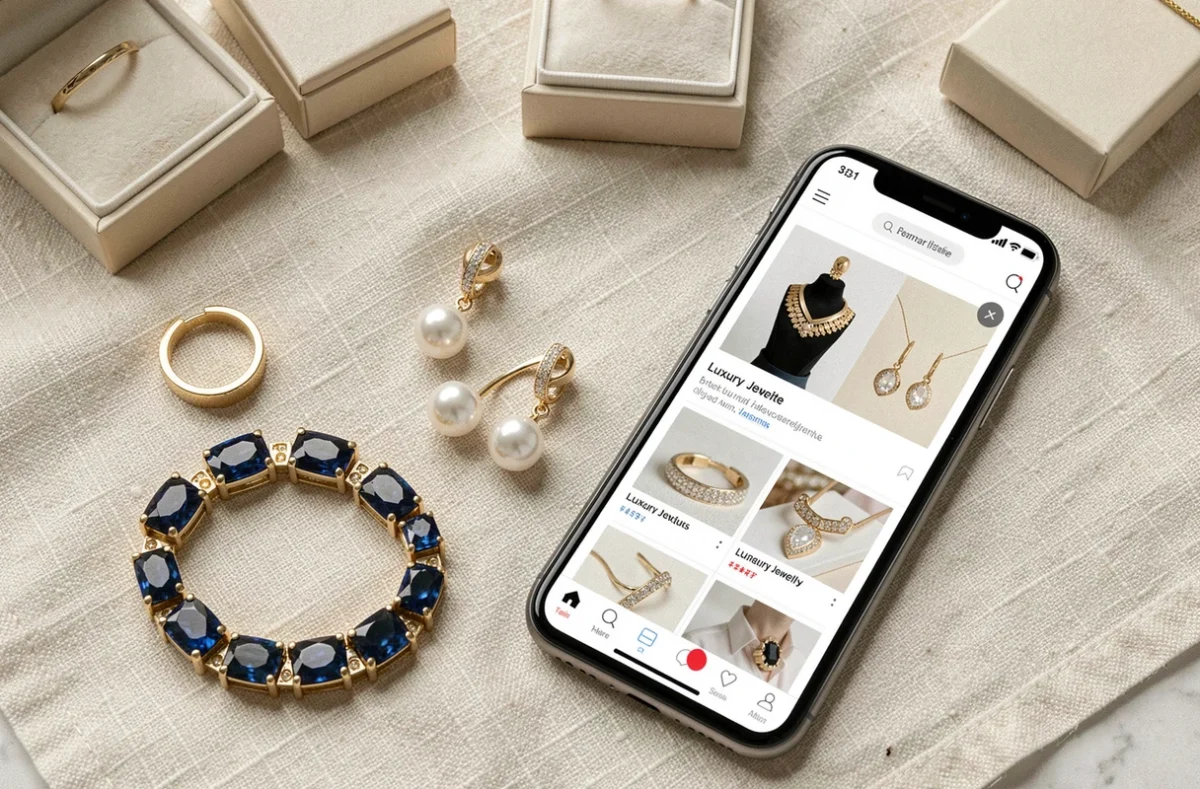
Purchasing from an individual, via a marketplace or social network, does not benefit from the right of withdrawal or the compliance guarantee. The gap in legal protection between these three channels justifies prioritizing identified jeweler sites, where one can calmly compare available pieces, just like doing shopping on Tiffany and Co directly from their dedicated interface.

Certificates and hallmarks: documents to demand before payment
A gemological certificate issued by an independent laboratory remains the only document that attests to the characteristics of a precious stone. For a diamond, this certificate details the four standardized criteria: cut, color, clarity, and carat weight. Without this document, there is no way to verify the actual quality of a stone online.
The hallmark, affixed by an assay office, certifies the content of precious metal. In France, the DGCCRF controls professionals involved in the buying and selling of precious metals. A site that does not mention the hallmark on its product sheets omits regulatory information.
What the certificate does not cover
The gemological certificate pertains to the stone, not the setting. The quality of the setting, the finish of the prongs, and the consistency of the metal polishing are not included in any standard document. These elements fall under the craftsmanship of the house, and only high-resolution photos or 360-degree videos allow for remote evaluation.
- Request the scan of the gemological certificate before finalizing the order, not just a mention like “certified”
- Check that the certificate number corresponds to an identifiable and consultable laboratory online
- Ask for a macro photo of the engraved hallmark on the piece, especially for gold or platinum rings and pendants
- Verify the consistency between the announced carat weight and that of the certificate
Traceability of precious stones: what the European digital passport will change
The European regulation on sustainable ecodesign (ESPR), in effect since July 18, 2024, introduces the principle of digital passports for certain categories of products. Jewelry is not yet subject to a specific act, but the regulatory framework is established.
This digital passport, when deployed for jewelry, will centralize the origin of materials, manufacturing conditions, and the exact composition of a piece. For the online buyer, this will represent direct access to the supply chain, where today only major houses voluntarily publish information about the traceability of their stones.
Anticipate traceability now
While waiting for this obligation, houses that already document the origin of their stones offer a higher level of trust. A diamond with an identified mine of extraction, a sapphire accompanied by a geographical origin report: these elements are measurable indicators of seriousness. A site that provides no information about the provenance of its precious stones falls below the expected standard for luxury.
Customization of jewelry online: legal limits to know
Engraving initials, choosing a specific metal, adjusting the size of a ring according to a template sent by the customer: these customization options change the legal nature of the order. A good made according to the customer’s specifications is excluded from the right of withdrawal under the Consumer Code.
This exclusion does not eliminate the legal compliance guarantee. If the delivered jewelry does not match the agreed characteristics (wrong alloy, different stone, incorrect engraving), recourse remains possible. The distinction is clear: one cannot return personalized jewelry simply because of a change of heart, but one can contest it if it does not match the order.
- Check before ordering if the product sheet explicitly mentions the exclusion of the right of withdrawal for personalized pieces
- Keep a screenshot of the validated specifications (metal, carats, engraving, dimensions)
- Request a digital proof for any engraving or custom modification before production
Shopping for luxury jewelry online relies on three verifiable pillars: a consultable gemological certificate, a photographed hallmark, and explicit return conditions. These three elements are either present or absent on the product sheet. Their absence is a more reliable warning signal than any customer review.